

Every day we wake up and go about our business. Life changes—mostly imperceptibly, incrementally, crawling season after season. We accept new streets, new buses, and new buildings as normal. What once was a field of flowers is now a parking lot, to paraphrase the famous song by Joni Mitchell, and before long, you might never know a field existed.
However, something happens when you visit a place over a very long period—like dots on a slow-moving ticker tape, you see the change as flashes. A decades-long timelapse. This is the case for me with my visits to the country of my birth, Sri Lanka. Every few years for 45 years, I have experienced the inexorable change wrought by globalization, industrialization, and urbanization. I can stand on a road in a metropolis and remember the field. I can saunter down my parents’ once-sleepy 1970s suburban laneway to bask in the shadow of a 20-story high-rise.
In Canada, I visited the Athabasca Glacier for the first time in July 2002. The glacier reaches the Icefields Parkway in Jasper National Park, one of the tongues of the Columbia Icefield. My last visit was 20 years later, in July 2022; the glacier had retreated so far that you had to walk 20 minutes from where I had seen it in 2002.
When it comes to our environment, in my lifetime I have observed three truths.
Firstly, humans change their environment. We are a species of terraformers. We have been doing this since we gathered in groups however many epochs ago. To ask us not to explore, to socialize, to make our environment better for our own survival is akin to asking us as a species to concede defeat.
Secondly, our environment has changed at our hands so massively, how can we not expect the knock-on effects to have an impact—like that butterfly causing a hurricane?
Thirdly, nature is far more resilient than the would-be terraformers. In 2019, I stood at the center of Chernobyl: nature had grown back; trees were exulting in the lack of humans. It is not the world we should be frightened for; it is ourselves. We make it sound as if by becoming a green society we are doing it for the planet. The truth is always: we are doing it to save our children, nature will survive and come back as weird and even more wonderful without us.
Unfortunately, the first truth has shown me that if we are to address the second and third truths, the biggest movers need to be our governments and industry. We can all do our part, for sure, but the biggest gains lie in more sustainable ways to change how we build out our environment, produce energy, and of course, travel, so that we can indeed circle the globe and be one human family.
The human story is one of technological advance, from the wheel to flight. We’ve made our world smaller, our minds bigger, and our hearts wider.
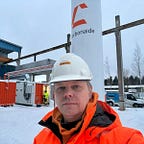
It is with that optimism that I know we can, and must, solve our challenges. It is why I am very happy when I see startups like the one my friend and former Supermetrics colleague, Kurre Stålberg, is a part of: Carbonaide.
In This Episode
In this conversation, Kurre takes us inside the industrial world of concrete curing—a sector responsible for a staggering 8% of global CO2 emissions. We discuss how Carbonaide is trapping carbon dioxide into concrete making the concrete “harder, faster, cheaper, and greener”.
We also dive into the reality of the “wild west” carbon credit markets, where only a fraction of sold credits are actually delivered , and Kurre shares his unique experience as a software engineer using an “army” of AI agents to build industrial platforms almost single-handedly.
Topics Covered:
The 8% Problem: Why cement production is so carbon-intensive.
The Solution: How Carbonaide primes concrete to “vacuum” up CO2, curing blocks in hours instead of days.
The Carbon Market Reality: The difference between buying “futures” and buying actual sequestered carbon.
AI as a Force Multiplier: How Kurre shifted from “developer” to “project manager” of AI agents to scale his output.
Links & Resources:
Carbonaide: https://carbonaide.com
Recommended Listening: If you want to listen to an amazing story about one of the biggest concrete jungles ever, I can recommend 99% Invisible’s episode “A River Runs Through Los Angeles”


